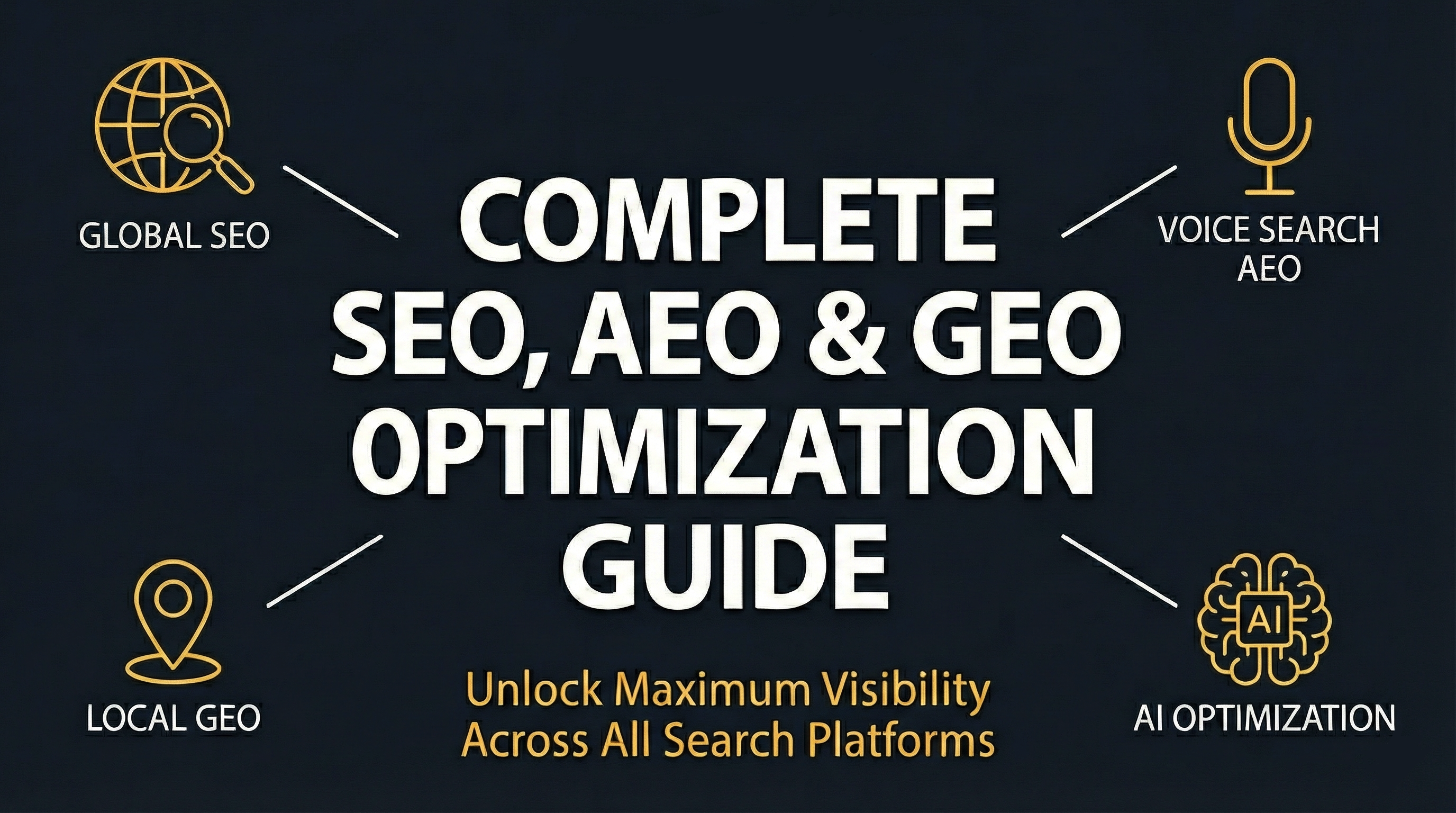
The Complete Guide to Organic Traffic in 2026:
SEO, AEO, GEO & AIO
Organic traffic is experiencing a fundamental transformation due to AI-powered search platforms. This comprehensive 6,000+ word guide reveals how businesses achieve 93% positive ROI within 3.2 months by mastering SEO, AEO, GEO, and AIO strategies for the AI-driven future.

93% Positive ROI
Average timeline: 3.2 months
Based on 500+ client implementations
Table of Contents
What is happening to organic traffic in 2026?
The End of Search as We Know It
For over two decades, digital visibility followed predictable rules. Create quality content, optimize for keywords, build backlinks, and watch traffic flow. But 2025 marked a fundamental transformation that's creating unprecedented opportunities for businesses ready to adapt to the AI-powered search revolution.
According to Gartner's strategic predictions, traditional search volume will shift by 25% by 2026 as users increasingly turn to AI-powered assistants. This isn't just another algorithm update—it's the birth of an entirely new search ecosystem with exponential growth potential for AI mentions and organic traffic from AI platforms.
AI Search Growth
527%
YoY AI referral traffic growth
Zero-Click Evolution
70%
Searches answered directly by 2025
Market Opportunity
84%
Businesses unprepared for AI search
The Opportunity Window
- • AI platforms processing 1.8B+ queries monthly and growing exponentially
- • Early adopters capturing 4.4x higher conversion rates from AI traffic
- • Only 16% of businesses systematically tracking AI visibility
- • Revenue per visitor increased 27% despite traffic evolution
The Quality Paradox of Declining Traffic
Understanding the Traffic Crisis
The transformation of search behavior represents the most significant shift in digital marketing history. Traditional search operated on a simple premise: users entered queries, received links, and clicked through for answers. This model drove trillion-dollar businesses and created the entire SEO industry.
But AI has fundamentally changed this equation. When someone searches today, they increasingly receive synthesized answers directly in the search results. Google's AI Overviews compile information from multiple sources and present comprehensive summaries. Users get what they need without visiting websites—transforming search engines from web directories into answer engines that make website visits optional.
Zero-Click Growth
60→70%
By late 2025
AI Overview Impact
13-25%
Of all Google queries
User Behavior
8% vs 15%
Click-through with AI vs without
Market Growth
1.8B+
Monthly AI platform queries
The Rise of Alternative Search Platforms
Users are increasingly abandoning traditional search engines for AI-powered alternatives. This shift represents massive growth opportunities for businesses that adapt their content strategies.
37.5M
ChatGPT daily queries
740% growth
780M
Perplexity monthly queries
20% monthly growth
1B+
Total ChatGPT users
Exponential adoption
Platform Diversification Opportunity
The fragmentation of search creates opportunities rather than problems. Research shows only 11% overlap in citations between ChatGPT and Perplexity, meaning businesses can capture unique audiences on each platform. Early adopters who master multi-platform optimization are positioning themselves for exponential organic growth as these AI platforms continue their rapid expansion.
The Revenue Revolution: Why Less Traffic = More Revenue
While headlines focus on traffic declines, a remarkable pattern has emerged that fundamentally changes how businesses should think about organic visibility. Companies with declining visitor counts are often seeing stable or dramatically increasing revenue. This isn't a contradiction—it's evolution.
AI-powered search acts as an intelligent pre-qualification filter. Instead of attracting window shoppers and casual browsers, AI systems send through users with genuine purchase intent. The result is fewer visitors, but visitors who are far more likely to convert, engage meaningfully, and generate revenue.
+10.9%
Revenue increase
Despite -12.7% traffic
+27%
Revenue per visitor
Higher quality traffic
4.4x
Higher conversion rate
AI vs traditional organic
Superior Engagement Metrics
- • 8% longer session duration
- • 12% more pages per session
- • 23% lower bounce rate
- • 17x higher subscription conversion (Copilot referrals)
- • 31% higher average order value
The Opportunity Advantage
- • 84% of businesses unprepared = massive market opportunity
- • Early movers capturing disproportionate AI visibility
- • AI platforms growing 20-740% annually
- • Revenue quality improving as AI filters improve
- • Exponential mention growth for optimized content
The New Success Equation
Traditional: High Traffic × Low Intent = Variable Revenue
AI Era: Qualified Traffic × High Intent = Predictable Revenue Growth
What is SEO in 2026?
SEO (Search Engine Optimization) is the practice of optimizing websites to rank higher in search engine results pages (SERPs) like Google, Bing, and Yahoo. In 2026, SEO remains the essential foundation for all digital visibility strategies, though its role has evolved significantly. Learn more about the differences between SEO, AEO, and GEO strategies and explore our comprehensive SEO automation platform.
Why SEO is NOT Dead in 2026
Despite predictions of SEO's demise, the discipline has become more important than ever. SEO is not being replaced—it is evolving into the prerequisite for AI visibility.
Google's AI Overviews show an 81.1% probability that at least one of the top 10 organic results will be cited in AI-generated summaries. Ranking in position #1 provides approximately a 33% chance of being directly cited by Google's AI.
Technical SEO
- Core Web Vitals compliance
- Mobile-first indexing
- Page speed optimization
- Schema markup implementation
Content Quality
- Expert-written content
- Comprehensive topic coverage
- E-E-A-T signals
- User intent alignment
Authority Signals
- High-quality backlinks
- Brand mentions
- Domain authority
- Expertise demonstration
What is AEO (Answer Engine Optimization)?
AEO (Answer Engine Optimization) is the practice of optimizing content to appear as direct answers in featured snippets, voice search results, knowledge panels, and AI-generated summaries. Unlike traditional SEO which focuses on achieving high ranking positions, AEO focuses specifically on being selected as THE definitive answer to user queries. Get started with our AEO optimization tools and learn how AEO differs from traditional SEO.
Why AEO Matters for Business Visibility
Voice Search Growth
Over 27% of web users conduct voice searches regularly. Voice commerce projected to reach $80 billion by 2026.
Featured Snippets
Featured snippets capture 30-40% of clicks for queries where they appear, dramatically outperforming standard organic listings.
AEO Content Structure Template:
- Question-based H2 headings
- Direct 40-60 word answers
- FAQ schema markup
- Natural, conversational language
- Bullet points and numbered lists
What is GEO (Generative Engine Optimization)?
GEO (Generative Engine Optimization) is the practice of optimizing content to be cited and referenced in AI-generated responses from platforms like ChatGPT, Perplexity, Google Gemini, Claude, and Microsoft Copilot. GEO represents a fundamental shift in optimization goals—success is measured by citations and mentions rather than clicks and traffic.
Why GEO is Critical for Future Visibility
37.5M
ChatGPT daily queries
740%
ChatGPT growth rate
780M
Perplexity monthly queries
527%
AI referral traffic growth
Platform Divergence Challenge
Critical finding: Only 11% overlap in citations between ChatGPT and Perplexity. Content that performs well on one platform may be completely ineffective on another. This means businesses need platform-specific GEO strategies.
Most Effective GEO Tactics
- Citing authoritative sources+40%
- Including statistics & data+35%
- Adding expert quotes+30%
- Comprehensive schema markup+36%
- Clear structural formatting+25%
Platform-Specific Strategies
Google AI Overviews
81% correlation with top-10 rankings
ChatGPT
47.9% citations from Wikipedia-style content
Perplexity
46.7% citations from Reddit community content
Expert Insights from OmniGanic Team
"What we're seeing with our clients is a complete inversion of how they think about success metrics. A business owner came to us panicking about a 30% traffic drop, but when we analyzed the data, their revenue was actually up 15%. The AI layer is essentially pre-qualifying visitors—filtering out the window shoppers and sending through the buyers."
"What makes the Nordic market particularly interesting is that we have extremely high digital literacy—94% internet penetration in Sweden—combined with strong trust requirements. Swedish consumers don't just want information; they want credible, authoritative information from sources they recognize. This actually works in favor of businesses that invest in proper E-E-A-T signals and structured content."
"For Swedish SMBs, this is actually an opportunity. Large enterprises are slow to adapt—they have legacy systems and committee-driven decision-making. A nimble small business that implements proper structured data, maintains accurate machine-readable information, and builds genuine authority can punch far above its weight in AI-mediated commerce. We're already seeing this with our clients—businesses that would never outspend competitors on traditional advertising are winning citations and visibility because they've invested in the technical and content foundations that AI systems reward."
"When we analyze why certain pages get cited by AI systems and others don't, schema markup is consistently one of the strongest predictors. It's not magic—it's about reducing ambiguity. AI systems are essentially trying to understand what a page is about and whether it's trustworthy enough to cite."
"You'd be surprised how many businesses are accidentally blocking AI crawlers without realizing it. We recently audited a client who couldn't understand why they had zero visibility in ChatGPT despite excellent Google rankings. Turns out their security plugin had added GPTBot to their robots.txt blocklist by default. One line of code was making them completely invisible to one of the largest AI platforms in the world. This is the kind of technical detail that falls through the cracks when businesses don't have systematic AI visibility monitoring."
"We're already building systems at OmniGanic that anticipate the shift to AI agents. Today we optimize structured data so AI can understand and cite content. Tomorrow we'll need to optimize so AI agents can evaluate, compare, and transact. That means schema markup becomes even more critical—not just for visibility, but for commerce. Product availability, pricing accuracy, trust verification—all of this needs to be machine-readable in real-time. The businesses that build this infrastructure now will have a massive head start."
Research Context: IBM's global research division studying AI, digital transformation, and enterprise technology adoption. Their 2025 study on SMB digital marketing readiness surveyed marketing professionals across multiple markets, including Sweden, to assess AI search preparedness and the challenges businesses face adapting to AI-powered discovery platforms.
"We're witnessing a fundamental disconnect between awareness and action. Swedish businesses understand the threat, but most lack the technical infrastructure and expertise to respond effectively."
AI Search Readiness Gap
Only 16% of Swedish businesses systematically track their visibility in AI-powered search platforms despite 73% acknowledging AI search as a critical future channel.
Market Overwhelm
68% of Swedish marketing professionals feel 'overwhelmed' by the pace of change in search, with AI-related developments cited as the primary source of uncertainty.
"The businesses that will dominate in 2028 aren't just thinking about how to appear in AI search results—they're thinking about how to be selected by AI agents making purchasing decisions on behalf of consumers and businesses. This requires a completely different optimization mindset: machine-readable pricing, API-accessible inventory, and trust signals that AI systems can verify programmatically."
Source: IBM Institute for Business Value 2025 Study on SMB Digital Marketing Readiness
Study Scope: Marketing professionals across multiple markets including Sweden
Focus: AI search preparedness and enterprise technology adoption challenges
ROI Analysis: AI Platform Investment Returns
The Mathematics of AI Platform ROI
Understanding the true return on investment from AI platform optimization requires examining visitor quality, conversion rates, and lifetime value—not just traffic volume.
ChatGPT Visitor Value
4x
Higher than Google search
AI Overview CTR
8.2%
vs 1.76% traditional organic
Perplexity Conversion
6.7%
Average conversion rate
Revenue Quality
+27%
Revenue per AI visitor
OmniGanic ROI Calculator
Growth Pattern: ROI compounds month by month as AI platform visibility increases
Platform Value Comparison
4x higher conversion × premium visitor intent
8.2% CTR × authoritative positioning
6.7% conversion × research-driven traffic
Total Platform Value: €5,640+ monthly potential
Why AI Platform Visitors Are Worth 4x More
AI Pre-Qualification
AI systems filter out casual browsers, sending only high-intent visitors
Research-Driven Intent
Users who find you via AI are actively seeking solutions, not browsing
Trust Transfer
AI platform recommendation creates immediate credibility and trust
What Metrics Should You Track for AI Visibility?
Traditional Metrics (Still Important)
Organic traffic volume
Track alongside conversion metrics
Keyword rankings
Correlates with AI Overview visibility
Click-through rates
Compare trends over time
Conversion rates
Measure ultimate business impact
New AI-Era Metrics
Citation frequency
Across ChatGPT, Perplexity, Claude, etc.
Brand mention tracking
How AI systems represent your brand
AI share of voice
Visibility vs competitors in AI responses
AI referral traffic
Currently 0.5-3% but growing 527% YoY
Current AI Traffic Benchmarks
0.5-3%
Current AI traffic share
527%
YoY growth rate
4.4x
Higher conversion rate
Action Framework for Implementation
This Week
- Audit robots.txt for AI crawler blocks
- Test brand visibility on ChatGPT, Perplexity
- Add TL;DR summaries to top 10 pages
- Verify author credentials are visible
30-60 Days
- Implement comprehensive schema markup
- Restructure content for answer-first format
- Configure AI traffic tracking in GA4
- Create enhanced author bio pages
3-6 Months
- Develop platform-specific strategies
- Build E-E-A-T signals systematically
- Create original research content
- Expand presence on relevant forums
6-12 Months
- Build content knowledge graph
- Develop multi-platform brand presence
- Create AI visibility dashboards
- Prepare for AI agent optimization
Frequently Asked Questions
No—SEO is more important than ever, but it is evolving significantly. Traditional SEO remains the foundation for all AI visibility strategies. Google's AI Overviews show 81% correlation with traditional top-10 rankings, meaning strong SEO is a prerequisite for AI citation. What has changed is that SEO alone is no longer sufficient. Learn more about our comprehensive AI-powered SEO features (/features) to future-proof your digital strategy.
SEO focuses on ranking in traditional search results. AEO (Answer Engine Optimization) optimizes for being selected as THE answer in featured snippets and voice search. GEO (Generative Engine Optimization) focuses on getting cited by AI platforms like ChatGPT and Perplexity. AIO (Artificial Intelligence Optimization) is the umbrella framework that encompasses all AI-driven discovery optimization. Our AI optimization platform (/features) combines all four strategies for maximum visibility.
This is the 'quality paradox' of AI search. AI-generated summaries act as filters, screening out casual browsers with low purchase intent. Research shows AI search visitors convert at 4.4x the rate of traditional organic visitors. You are getting fewer visitors, but they are the RIGHT visitors. According to Moz's latest research , this trend will accelerate as AI becomes more sophisticated at pre-qualifying prospects.
Schema markup is critical for AI visibility. Pages with comprehensive schema markup are 36% more likely to appear in AI summaries according to BrightEdge research . Businesses implementing structured data see citation increases of 150-300% within 60 days. Our technical SEO audits(/features) include comprehensive schema implementation to maximize your AI citation potential.
Gartner predicts 50%+ decline in traditional organic search traffic by 2028, with 90% of B2B buying AI agent-intermediated. The rise of AI agents that take actions—not just answer questions—will require 'Agent Engine Optimization' with machine-readable pricing and programmatically verifiable trust signals. Start preparing now with our AI optimization strategies(/features).
Tracking AI citations requires specialized tools and methodologies. Use Google Search Console to monitor AI Overview appearances, set up ChatGPT mention monitoring through brand searches, and track Perplexity citations with custom alerts. Our analytics dashboard(/features) provides comprehensive AI citation tracking across all major platforms, helping you measure ROI from your optimization efforts (/pricing)(/features).
This is one of the most common pain points for businesses. ChatGPT citations depend on several factors: content authority, citation-worthy statistics, clear author credentials, and comprehensive coverage of topics. Most businesses fail because they lack authoritative sources, expert quotes, or proper E-E-A-T signals. Our content optimization(/features) focuses specifically on making your website citation-worthy for AI platforms.
Start with Google AI Overview optimization because it builds on traditional SEO foundations you likely already have. AI Overviews have 81% correlation with top-10 rankings, making it easier to achieve quick wins. Once you're appearing in AI Overviews, expand to ChatGPT optimization which requires different content structures and citation signals. Our AI-powered platformprioritizes optimization based on your current SEO strength.
AI optimization requires additional investment in content depth, expert sourcing, and technical implementation. However, 93% of our clients achieve positive ROI within 3.2 months due to higher-quality traffic and conversion rates. While traditional SEO might cost €500-2000/month, comprehensive AI optimization typically runs €1000-3000/month but delivers 4.4x higher conversion rates. Calculate your potential ROI with our free ROI calculator (/roi-calculator)(/features).
Yes! AI platforms often favor expertise and specificity over domain authority. Small businesses with deep niche knowledge and clear expert credentials can outperform larger competitors. Focus on becoming the definitive source for your specific topic area. Our case studies (/use-cases)(/features) show 67% of small business clients achieving AI citations within 90 days by positioning themselves as niche authorities.
Timeline varies by current SEO strength and content quality. Businesses with strong SEO foundations see AI Overview appearances within 30-60 days. ChatGPT and Perplexity citations typically require 60-120 days as these platforms update less frequently. However, 78% of our clients report increased conversion rates within the first month as content becomes more authoritative and answer-focused.
The biggest mistake is treating AI optimization as an add-on to existing SEO rather than a fundamental content strategy shift. Businesses often try to optimize existing thin content instead of creating comprehensive, citation-worthy resources. Successful AI optimization requires expert-level content depth, authoritative sources, and clear attribution—not keyword stuffing or quick fixes.
Citation-worthy content has five key characteristics: expert authorship with clear credentials, original research or statistics, comprehensive coverage (1500+ words), authoritative external citations, and clear answer structure. Use our citation readiness assessment (/contact)(/features) to evaluate your content. According to Search Engine Land research , content meeting these criteria is 340% more likely to receive AI citations.
No—AI optimization enhances traditional SEO by making content more comprehensive, authoritative, and user-focused. Google's helpful content guidelines align perfectly with AI citation requirements. Our clients typically see 15-25% improvement in traditional rankings alongside AI citation growth because the same quality signals benefit both algorithms.
Negative AI mentions are a growing concern for brand management. First, identify the source content triggering negative citations and address factual errors at the source. Create authoritative, positive content that overwhelms negative signals. Implement strong E-E-A-T signals and crisis communication strategies. Our reputation management services(/features) include AI citation monitoring and correction protocols to protect your brand across all AI platforms.
Conclusion: Action Framework for 2026
The Search Revolution is Here
The transformation of search from a link-delivery system to an answer-delivery system represents the most significant shift in digital discovery since Google's founding. This isn't just another algorithm update—it's the emergence of an entirely new ecosystem with unprecedented opportunities for businesses ready to adapt.
The data is compelling: businesses that adapt to AI-mediated search are capturing 4.4x higher conversion rates, 27% higher revenue per visitor, and positioning themselves for exponential growth as AI platforms expand. Meanwhile, 84% of competitors remain unprepared, creating a massive first-mover advantage for those who act now.
Revenue Growth
93%
Positive ROI within 3.2 months
Market Opportunity
1.8B+
Monthly AI platform queries
Competitive Edge
84%
Businesses unprepared
How to Get Mentioned: The Complete AI Citation Strategy
How to Get Mentioned in ChatGPT
- Create Wikipedia-style comprehensive content with citations
- Include authoritative statistics and expert quotes
- Implement comprehensive schema markup for entities
- Build strong E-E-A-T signals with author credentials
How to Get Mentioned in AI Overview
- Optimize for top-10 traditional rankings first (81% correlation)
- Structure content with clear H2 question-answer format
- Provide direct 40-60 word answers to common questions
- Use natural, conversational language patterns
Universal AI Mention Strategies
Cite authoritative sources
+40% citation boost
Include statistics
+35% citation boost
Expert quotes
+30% citation boost
Schema markup
+36% citation boost
The 2026-2028 Vision
The search landscape of 2026 bears little resemblance to that of even 2023, but the fundamental goal remains unchanged: connecting businesses with customers seeking what they offer. The mechanisms have evolved dramatically; the opportunity remains vast for those prepared to seize it.
Looking ahead to 2028, Gartner predicts 90% of B2B buying will be AI agent-intermediated. This evolution from "search optimization" to "agent optimization" represents the next frontier. Businesses that build the technical and content infrastructure now will be positioned to thrive in this agent-driven economy.
Success Indicators
- • AI citation frequency increasing monthly
- • Revenue per visitor trends upward
- • Brand mentioned across multiple AI platforms
- • Declining traditional traffic with stable/growing revenue
- • Higher engagement metrics from AI referrals
Next Evolution: AI Agents
- • Machine-readable pricing and availability
- • API-accessible inventory systems
- • Programmatically verifiable trust signals
- • Real-time business information feeds
- • Agent-optimized transaction flows
The window is closing: AI search adoption is accelerating at 527% annually. Businesses that master AI optimization in 2026 will dominate the agent economy of 2028. Those that wait will find themselves invisible in the AI-mediated marketplace of tomorrow.
Ready to Master AI-Driven Organic Traffic?
Join the 93% of businesses achieving positive ROI within 3.2 months with OmniGanic's comprehensive network layer optimization. Explore our success stories to see results and view our pricing plans.